Tuesday, July 03, 2012

Eccentric Spaces by Robert Harbison

John Soane House, London
I have picked at this book for years, finally deciding to read it straight through back in 2010. I keep my edition with my architecture books, but it is just as much a work of aesthetics and literary analysis. Harbison's themes are imagination and artifice in the human environment. He begins - as does man's mythic history - in the garden, where man seeks paradoxically to replicate and control the wildness of nature. He moves through various literary environments, such as Holmes' Baker Street sanctum (and what it says about the peculiar English concept of home, and the British comfort of living ensconced in a "pre-Freudian past"), the architectural oddities of Walpole's Strawberry Hill and the John Soane house, the Italian scene from ancient Rome down through Ruskin's Venice, Hawthorne's Marble Faun, Corvo's grotesque Don Renato and Radcliffe's gothic Mysteries of Udolpho. There is a masterful extended summary of Colonna's bizarre Hypnerotomachia Poliphili. Harbison looks at the deliberate alienness of Flaubert’s Salammbo and the strange inertia of Pater’s Marius the Epicurean, which makes reference to one of Pater’s tweedy descendants:


It is a book of not doing and not being various things most people do and are, and is set in a remote time as a way of saying I cannot hear you, or I could not heed you so finally I can no longer hear you, or I could not heed you so finally I can no longer hear you. The book shows nothing as pronounced as renunciation, but makes a drama of abstention, the things one has not done are more memorable, life lies in deliberately unused possibility which is a preserved youth. Pater resembles in this his descendant C.S. Lewis, another cloistered child-scholar, who creates even more emphatically than Marius a life based on a dreamed recollection of generalized childhood.


The concluding essays address the world in miniature, our attempts to circumscribe, and, in a sense, immobilize the human landscape and artifacts through maps, museums, and catalogues.


Plan of William Beckford's Fonthill Abbey
Harbison’s book is, in part, a thoughtful commentary on semi-obscure literature such as Rodenbach’s Bruges-la-Morte, Huysman’s La Cathedrale (“Like all converts, Huysmans supposes he does the faith a favor by becoming interested in it…”), and the aforementioned works of Colonna and Corvo. He also works in the obvious candidates, such as Kafka, Joyce and James. I have largely neglected to mention his no less impressive commentary on art and architecture, particularly that of Renaissance and 16th century Italy. Although Harbison’s arguments can induce some brow-wrinkling as one attempts to puzzle out his perspectives, as a whole, Eccentric Spaces is a remarkably engaging intellectual experience.


Sunday, June 24, 2012

The Prague Cemetery by Umberto Eco

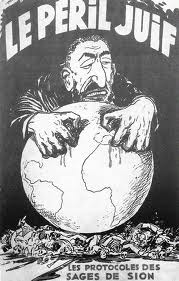
Many of the world’s anti-semites live in blissful disregard of the false paternity of The Protocols of the Elders of Zion, a document which purports to record a secret conclave of Jewish elders as they lay out their insidious plan for world domination by undermining the financial and moral foundations of the West.  Many years ago, in Texas, a co-worker loaned me his copy of the pamphlet, which he in turn had received as a premium from a small-town service station owner who, like Henry Ford before him, felt that this vile fabrication was deserving of a wider audience.


Arriving at the turn of the 20th century, and discredited as fabrication cobbled together from fragments of fiction and fantasy soon after, the Protocols were inessential for the Jew-hater, but they held, and in some quarter still hold, a place of honor as proof positive that the slanders of centuries were true, that the Jews, the rats inhabiting the cellar of humanity, were laying humbly in wait for the moment to strike at the bosom of the Christian West. Every move of the Jew was, almost by definition, deceptive and manipulative: they suffered (or, some might say, exploited) the degradations of the ghetto and the periodic pogroms as they bided their time. They secretly encouraged godlessness and the freedoms of the so-called “Enlightenment” in order to weaken the power of the Church and the princes of the West, and to encourage a moral laxity that would rot civilization from the inside.


We love a conspiracy, because we love the feeling that we are in possession of a great truth, the feeling that we have stolen a look behind the veil and have seen the world as it really is, not as the false reality that the foolish take at face value. And we love a scapegoat - a people on whom we can blame the ills of society. Any scapegoat will do, but few have had the pedigree of the Jews, who reached a climax of vulgarity when they murdered the Savior of the World, and duly suffered for it while paradoxically nurturing a secret network, digging labyrinthine tunnels beneath the bulwarks of order because they had a master plan (conspiracy is meaningless without a master plan) to enslave humanity and avenge the ills visited upon them for their deicide. For those willing to believe, the West has been in a race for centuries against this threat, which those in power have been content to ignore, for their wealth and power come from their being in cahoots, being willing to sell out their own for their own gain. There were occasional “cleansings” -slaughters and burnings - but a final solution was elusive, the Jews being protected by those they had manipulated into thinking they had something to gain by shielding them from all but minor harassments.


Such is the fantasy, such is the slander which led to the great conflagration of the last century, a pyre which the Protocols played their part in igniting. One must commend Umberto Eco, a 20th/21st century European, for being willing to scratch at the scab of anti-semitism and show us the proximate roots of that Holocaust. Ingeniously, and with his customary erudition, he weaves a novel of the strands of 19th century violence and social upheaval, of the various spectres haunting Europe. As he has made clear in interviews, all the characters save one (the central one) are actual, historical figures. Eco’s skill is to - as he did with his masterwork of occult conspiracy, Foucault’s Pendulum - construct a credible narrative of disparate elements which moves towards an inevitable and preordained (by subsequent history) conclusion. The fact that he can sustain this narrative for almost 450 pages under the narration of one of the most noxious characters in recent fiction, the repulsive forger Simone Simonini is, in itself, a commendable feat.


The plot itself defies easy summary. Needless to say (and again as with Foucault’s Pendulum) the attentive reader will have fun noting in the margins the dizzying references to a plethora of literary and historical figures, and if one is so inclined, reading the novel with Wikipedia close at hand might be fruitful as well, if one is unacquainted with, for instance, the works of the once popular and now forgotten novelist Eugene Sue (author of The Mysteries of Paris and The Wandering Jew) and a couple dozen other historical figures besides. One would have to be remarkably well-versed in European history to not need a crib sheet on, for instance, the Risorgimento or the Dreyfus Affair, as a means of deciphering Eco’s multi-layered narrative. Still, for those willing to spend some time and effort in unfamiliar territory as a means of gaining new insight into the origins of one of the most contemptible horrors of the 20th century, the exercise will be enlightening and - if it’s not inappropriate to say - entertaining.


Thursday, March 15, 2012

Homo Sapiens: A Novel in Three Parts by Stanislaw Przybyszewski

*Spoilers Ahead*


Published in the years 1895-96, Przybyszewski’s Homo Sapiens is a trilogy of novellas comprised of Overboard, Under Way, and In the Maelstrom, detailing the rise and moral unraveling of a young Polish author in 1890’s Berlin and, according to George Schoolfield in his A Baedeker of Decadence, contains more than a modicum of autobiographical reference. Erik Falk is an aspiring superman and nascent anarchist who, in these episodes, leaves a trail of suicide and broken spirits in his wake. The first novella describes his seduction of Isa, the girlfriend of an original and promising artist (modeled after Edvard Munch). Self-satisfied, he escapes with his prize even as the artist kills himself in despair. In the second installment, Falk, now with a wife and child at home, goes on an extended trip to his home town, and there becomes obsessed with the seduction in mind and body of a pious young girl. With his mission accomplished, he again takes his leave. Abandoned, and learning that Falk has a wife and son back in Berlin, the girl drowns herself in the river.


In the Maelstrom continues Falk’s downward spiral. Already an alcoholic, and with yet another mistress and child hidden discreetly away, he becomes obsessed with threats by an acquaintance, a former political ally with whom he has fallen out, to reveal his secret life to Isa. Falk brings others into a web of deception, and, when deepening despair brings him to thoughts of suicide, he finds himself lacking the courage, and so goads another anarchic socialist acquaintance, who maintains some curiously bourgeois sensibilities, into challenging him to a duel of honor in the hope that the man will kill him. But fate has other plans, and, now abandoned by his wife, Falk gets out with nary a scratch. Buoyed by a sense of egotistical invincibility and cleansed, through monomania and psychic degradation, of all the binds of family and social obligation, he coolly picks himself up, finds another woman, and strides off to begin again.


Homo Sapiens was published in English translation by Knopf in 1915, with a laudatory introduction praising Przybyszewski as Poland’s greatest living author. However, as Schoolfield notes, the “obscenity” of the subject matter, combined with the author’s pro-German sympathies during the First World War effectively marginalized him from the English-speaking world. Some of his works, including the 1915 edition of Homo Sapiens, can be found on Internet Archive, albeit in a somewhat overwrought translations which would likely benefit by some updating. The political concerns of the time, which result in a couple of long digressions in the book, hold no special interest for most readers anymore, but Schoolfield’s essay gives a good overview of the presence of the anarchic terrorist in a surprisingly wide range of works of the time from Conrad to Bely, and from Conan Doyle to Chesterton. The theme of the Nietzschean anti-hero who abandons the strictures of conventional morality was becoming a convention of philosophical literature at the time this trilogy was written, and would continue through to Brecht’s Baal and beyond. If you can deal with the issues inherent in a translation almost a century old, I’d recommend fellow devotees of decadent literature to seek this one out.

Friday, February 03, 2012

From The Meadows of Gold by Mas'udi

Translated by Paul Lunde and Caroline Stone, and issued in 2007 in Penguin’s “Great Journeys” series, this volume is a small selection from Mas’udi’s massive historical encyclopedia Meadows of Gold and Mines of Gems, of which the only other English translation appears to have been the volume published in 1841 by Aloys Sprenger under the auspices of the Oriental Translation Fund of Great Britain. A complete translation of the five volumes would be a daunting task. It appears that the Penguin selection functioned as a preview of a larger work envisioned for publication as a Penguin Classic, however, I have found no indication that this project is advancing.*

Written in the tenth century in Baghdad, Meadows of Gold and Mines of Gems is an encyclopedic universal history, based not only upon Mas’udi’s researches, but on his extensive travels as well. He gives descriptions of the lands and customs of Islamic Spain, the Mediterranean, Frankish Europe, the Norsemen, the Slavs, and the various tribes of the Caucasus and beyond. He also ventures descriptions of Egypt and Africa, India, China, Southeast Asia, and the Indonesian archipelago. This volume, being such a radical abridgement, gives but a taste of the larger work, to which Mas’udi brings a remarkably cosmopolitan eye.

In the Sprenger edition, Mas’udi notes that he has given his work a rich name “in order to excite a desire and curiosity after its contents, and to make the mind eager to become acquainted with history.” Having perused the Sprenger, I would have to say that it is a real treat, a fountain of lore beginning with the creation of the world, tracing, in the Arabic iteration, the story of the Old Testament and the life of Jesus, moving on to the history and religion of the Indian subcontinent, then to a general discussion of geography and astronomy, seas and rivers, oceanography, the Chinese Empire, island peoples, Spain, perfumes, the Caucasus tribes (with special attention to the Khazars, who adopted Judaism after conference with representatives of the three Abrahamic religions), Russia, the Byzantine Empire, and an entertaining diversion regarding the distribution and astonishing habits of monkeys.

The present translation, though laudable, doesn’t hold a candle to the 1841 edition, which one can easily access through Internet Archive. The Penguin is, for me, too disjointed, breaking the narrative into mostly short paragraphs on diverse subjects (the histories of chess and backgammon, electric catfish), which are, by turns, informative and fantastic. Still, in any version, Masu’udi is an entertaining guide, deserving of his reputation as an Arabic Herodotus, a prodigious traveler, historian, and naturalist. Sadly, only two of his known thirty-six works have survived. Despite lapses into pedantry, they are deserving of a larger audience.

*Apparently a selection focusing exclusively on Mas'udi's account of the Abbasid Dynasty has been published.

Tuesday, November 08, 2011

The Circus of Dr. Lao by Charles G. Finney

A charming and satiric fantasy. Dr. Lao's circus pulls into the dusty little town of Abalone, Arizona, beguiling the jaded residents with impossible creatures and tapping into their deepest dreams and desires. Published in 1935, Finney's book is escapist entertainment, but with a particular bite. The residents are, for the most part singularly unimpressed with the parade of chimeras, satyrs, sea serpents, hermaphrodites and unicorns.


Dr. Lao is a stereotypical eastern sage, speaking in an appropriately musical Charlie Chan voice, herein exasperated with a family of skeptics:

"Whatsah mattah? You tink someblody makeum fool allah time. I no fool you. You come this place looky look; you looky look. By Glod, I no charge you nothing. You go in flor nothing; takeum whole dam family flor nothing. You see: I no fool you. This place no catchum fake. This my show, by Glod!"

But falling into carney-speak when the mood strikes:

"Don't be foolin' with that animal, mister..."

While the men attend a risque tent show, the town Lonelyhearts consults Apollonius of Tyana for a fortunetelling session, a session in which, at wit's end at the woman's persistence, the oracle is forced to give it to her straight:

"Well, I paid you, read my future."

"Tomorrow will be like today, and the day after tomorrow will be like day before yesterday," said Apollonius. "I see your remaining days each as quiet, tedious collections of hours. You will not travel anywhere. You will think no new thoughts. You will experience no new passions. Older you will become but not wiser. Stiffer but not more dignified. Childless you are, and childless you shall remain. Of that suppleness you once commanded in your youth, of that strange simplicity which once attracted a few men to you, neither endures, nor shall you recapture any of them anymore. People will talk to you and visit with you out of sentiment or pity, not because you have anything to offer them. Have you ever seen an old cornstalk turning brown, dying, but refusing to fall over, upon which stray birds alight now and then, hardly remarking what it is they perch on? That is you. I cannot fathom your place in life's economy. A living thing should either create or destroy according to its capacity and caprice, but you, you do neither. You only live on dreaming of the nice things you would like to have happen to you but which never happen; and you wonder vaguely why the young lives about you which you occasionally chide for a fancied impropriety never listen to you and seem to flee at your approach. When you die you will be buried and forgotten and that is all. The morticians will enclose you in a worm-proof casket, thus sealing even unto eternity the clay of your uselessness. And for all the good or evil, creation or destruction, that your living might have accomplished, you might just as well has never lived at all. I cannot see the purpose in such a life. I can see in it only vulgar, shocking waste."

"I thought you said you didn't evaluate lives", snapped Mrs. Cassan.


The evening ends in a an impossible phantasmagoria under the bigtop, with a full scale sacrificial ritual to the great god Yottle complete with virgins, a spectacular from which the townsfolk file out and home to bed, to rest and rise another day.

Finney supplies a detailed and hilarious appendix cataloging in minute detail the residents of the town, the beasts, and the questions and contradictions in the book that pass unresolved. The Bison Books edition includes the wonderful illustrations by the appropriately exotically named Boris Artzybasheff. Terrific fun.


A Voyage to Arcturus by David Lindsay

I have no critical expertise with regard to science fiction, and don’t count myself as a particular fan of the genre, but no such expertise is necessary in making the assertion that A Voyage to Arcturus is a seminal novel with far reaching influence in the realms of science fiction and fantasy. Published in 1920 in the aftermath of the Great War, Lindsay’s novel represents a quest for a utopia, a philosophical search for the ideal condition to which man must aspire, but doomed to end in the pessimism which was the enduring legacy of that war. Tweedy ol’ Professor Lewis found in this book inspiration for his own Space Trilogy, and recommended it highly to Professor Tolkien. Decades later, Harold Bloom praised the novel enthusiastically, and, picking up on the many Gnostic elements in the tale, attempted a sequel, a Gnostic fantasy entitled The Flight to Lucifer.


There are certainly others who have made a touchstone of this novel. It is a classic of science fiction, but not the comparatively mundane sci-fi of Verne and Wells, but rather a whole different breed. There is little in the way of hardware or mechanics of space travel: there are no ray-guns or esoteric technologies (the means by which the protagonist, Maskull reaches the Arcturian planet Tormance is almost laughable: the flimsy spacecraft is projected back to Arcturus by means of some “reverse rays”, kept corked in a bottle, which travel back to their source), but one can easily imagine the producers of a film like “Avatar” seeking inspiration in the exotic and dynamic life forms of Tormance.


The hero Maskull, who is himself a bit of an odd duck on planet Earth, witnesses a strange physical manifestation during a séance in an English country house. He is approached by a stranger, the demonic Krag, who proposes that he and a companion meet at an abandoned observatory in order to partake in a particular adventure – travel to the region of Arcturus, a distant binary star system. The scenes in the observatory are weird enough, for the structure is clearly a portal through time and space, but once on Tormance, the magical mystery tour begins in earnest. I won’t catalogue the personalities Maskull encounters in the strange realms of this distant world. His adventures are rather episodic, with each encounter exemplifying a particular lifestyle seen by its adherents as ideal, and while there are various ethical and moral viewpoints presented, Lindsay most definitely has some perspectives on sexuality that were ahead of their time.


Once on Tormance, Maskull finds he has the peculiar ability to sprout (and lose) extra limbs and manifest new sense organs as necessitated by the situation. This seems to be entirely appropriate to the planet, which in itself seems to be in a constant state of dynamic change. There are strange life forms and landscapes that seem to mutate constantly, and new colors occasioned by the fact that each of the two suns around which the planet revolves emit an idiosyncratic spectrum of light. One can detect some Buddhist concepts floating around in this novel, none perhaps so obvious as the Buddha’s admonition that “change is inherent in all things”: on Tormance, change appears to be fast and constant. Lindsay invents some remarkable descriptions for the planet, and they are one of the beauties of this well-imagined novel.


Another peculiarity of Tormance is that it appears to be a sort of ghost world. The entities that Maskull encounters are almost all solitary, or at least live in solitary surroundings. Again, there is no indication of “civilization”, and no evidence of advanced technologies. The higher powers, which must be imagined as dieties, seem to be specific to the planet, and do not seem to possess omnipotence, another mark of the Gnostic demiurge. It almost seems to be a planet of anchorites, each integrated into a unique landscape, or perhaps into its own private heaven or hell.


Maskull was invited to Tormance with the full understanding that his death would be inevitable. The few days’ time in which the narrative takes place form a quest, a quest for a Gnostic demiurge known variously as Shaping, Surtur, and Crystalman (the latter being known primarily through the sardonic death mask which reshapes the face of the deceased immediately after death - a remembrance, perhaps, of the war dead Lindsay had seen in the trenches). One must also mention that Maskull has the odd and disturbing compulsion to murder just about every sentient being that crosses his path on this alien world, either through anger, self defense, or simple misadventure. Maskull is quite the fickle soul, making an earnest promise to the first ethereal space sylph he meets to abstain from eating any living thing during his sojourn (the intoxicating water should suffice), but abandoning the vow at the first whiff of some extraterrestrial barbecue. In fact, for all his avowed independence, Maskull seems to be putty in the hands of every alien he meets, coming round to each of their unique philosophical points of view with alarming facility. The downside of this (for the alien, that is) is that he doesn’t need much persuasion to bash one alien’s head in with a handy rock so that he can move on to the next chapter of his intergalactic pilgrim’s progress, for Maskull is heading for a revelation, and he ain’t got time to waste.


Fascinating as it is in places, A Voyage to Arcturus has, through much of its narrative a rather tedious quality for the 21st century reader. It is one of those influential novels the daring of which has become blunted with time and imitations, but which was close to inaccessible for its contemporaries. It is certainly a necessary read for anyone interested in the roots of modern fantasy and science fiction. It is available as a volume in Gollancz’s excellent “Fantasy Masterworks” series, and in an edition of Bison’s equally worthwhile “Frontiers of Imagination” series.


Thursday, October 13, 2011

The Three Imposters by Arthur Machen

The press notices included in the appendix to my Everyman edition of The Three Imposters (1895) testify to the almost universal revulsion this novel induced upon publication. The Liverpool Mercury - which one must assume comes down firmly on the side of the necessity of moral fiction - reported that “(n)o one can be made happier or better by such a book as this, but on the contrary the reader’s mind is likely to become stored with images and ideas that cannot but have an undesirable effect.” The Liverpool Courier was even more blunt in declaring “Ugh! A more repulsive catalogue of horrors it would be difficult to imagine, and its existence can only be attributed to the occasional perversity of man.” Other reviewers simply found the book unimpressive, and derivative of the recent work of Stevenson, particularly his New Arabian Nights, a debt which Machen seems to readily acknowledge in his characterizations and plot devices. In short, Machen tended to be seen as a sensationalist, dwelling on the ugly and repulsive, and making the clear choice of reveling in the descriptive horror of the grotesque, rather than leaving anything to the imagination. Machen himself disavowed all but a couple of episodes in the book.


From a distance of more than a century, we can appreciate the book on its own merits, and recognize its publication as a signal event in the development of the fiction of the weird and uncanny. This novel is, to me, greater than the sum of its parts, although the parts have merit on their own. Within the frame story of the elusive character of the “young man with spectacles” the book is largely a collection of tales of the demonic and grotesque, there are weird tentacled humans, dripping with slime such as might warm the heart of a Lovecraft fanatic (as it did Lovecraft himself), a Jekyll and Hyde character (another homage to Stevenson) who taps into his atavistic demons in the “Novel of the White Powder”, and a secret society whose tentacles are metaphorical, if none the less deadly. There are scenes of grisly torture, and a moment or two of grim humor besides (note: always read the instructions for your new torture devices before operating!).


The novel utilizes a minor “a long the riverrun” device, and I can’t imagine turning the last page without proceeding immediately to the first, as the ending elucidates the Prologue. Beyond the individual stories told by the so-called “imposters”, there is an undercurrent of deception and evil intent. The imposters are on the trail of the gold Tiberius, a rare talismanic coin which serves as this novel’s macguffin. The central pigeon is a Mr. Dyson, a hapless figure only slightly less clueless than his friend, Mr. Phillipps. It is he who hears from the imposters the series of improbable tales regarding the (supposedly) sinister young man with spectacles, and the two are witness to the morbid denoument in a dilapidated mansion on the outskirts of London.

The Three Imposters is an extended piece of strange fiction which enthusiastically utilizes Machen’s favorite themes of cruel human obsession and demonic atavism as presented in The Great God Pan and The Hill of Dreams. It is an entertaining work, with a nice balance of horror and humor, and it has survived its critics to become a classic of the genre.


Tuesday, September 06, 2011

Two Novels of Horror and Suspense from the 1970s

William Hallahan's The Search for Joseph Tully is one of a number of supernatural thrillers dating from the late 60’s-early 70’s that include Rosemary’s Baby, The Other (see below), and the best of the lot, The Exorcist. This particular story centers on a dual narrative involving Peter Richardson, a Brooklynite having horrible, maddening premonitions of death, and Matthew Willow, a British genealogist searching for the descendants of one Joseph Tully, a resident of London in the year of Our Lord 1779. The book is a decent page turner, even though one figures out pretty quickly just how the narratives are likely to intersect in the latest iteration of the eternal recurrence of a revenge narrative necessitated by events in the gruesome prologue, set in a Roman catacomb in 1498, in which two bound men are sickeningly pierced, sliced and decapitated by a red hot sword. The dramatis personae are mainly the residents of Brevoort House, a decrepit building awaiting the wrecking ball and include the obligatory clairvoyant; an artist who dies trying to warn Richardson of his impending doom by means of a creepy mural; and a defrocked priest with a deep interest in the teachings of Giordano Bruno regarding the transmigration of souls. The story attempts to make genealogical research sexy - with limited success – although this angle does underline the perspective that we are attending to a story that spans centuries and the lives of numerous individuals. Mr. Hallahan apparently had an abiding interest in Pre-Revolutionary American, having written a couple of nonfiction works set in this time frame, and he fleshes out this book with descriptive passages on life in the wilds of colonial New Jersey.

This book is nicely atmospheric, with the backdrop of a suitably bleak winter with the wind cutting through the pages like a steel blade (hint, hint). Still, I found the ending unsatisfyingly abrupt for my taste. It seems Millipede Press brought out a nice new edition of this book a few years ago, but Hollywood apparently resisted the temptation to add it to the list of supernatural horror flicks that deluged theaters in the wake of the film adaptations of the aforementioned works.


A subgenre of the thriller/horror film trend of the early 1970’s was the gruesome “evil child” melodrama, one of which was derived from Thomas Tryon's novel The Other. Tryon’s novel is indeed gruesome and melodramatic, as well as gratingly pretentious in places. But it has not aged too badly, despite having been subsequently swamped by the Stephen King tidal wave of popular horror fiction. It has all the hallmarks of latter-day gothic – a creaky and labyrinthine old New England house, strange children with strange powers, insanity, a family seemingly under a dark curse, comfortingly predicable plot twists, and a satisfyingly sufficient number of creepy deaths. There are those who hail The Other as a significant work of modern horror, and, not having read widely in modern horror, I won’t argue the point. A quick and passably entertaining read.

Thursday, July 28, 2011

The World Through Blunted Sight: An Inquiry Into The Influence of Defective Vision On Art and Character by Patrick Trevor-Roper


This book has gone through a few editions since its first publication in 1970. I first read it many years ago (I seem to associate it with a rather enthusiastic recommendation by Anthony Burgess), and was pleased to find that my enjoyment has not diminished on a second reading. Written by a renowned ophthalmologist, it looks at specific visual deficiencies and their effects on art and artists. In another sense, it is also an examination of how our perception of the world is influenced by the brain’s interpretation of sensory, particulary visual, stimuli.

Trevor-Roper is an enthusiastic author, with a knowledge of evolutionary biology as well as art history, and writes particularly well on ophthalmological conditions with a minimum of jargon. The book is loaded with anecdotes and interesting divergences (for instance, it is remarked that Aristotle, Milton, and Goethe shared the belief that there were only three colors evident in a rainbow), although I would have to say that some of Trevor-Roper’s assertions and conclusions strain credibility (I believe that his identification of personality types based on visual acuity are rather broad and clumsy, ignoring much more significant factors). He also has a Eurocentric - or rather a latent Imperial - bias that is too easily dismissive of “primitive” art in favor of the “high” art of Constable, Turner, El Greco and Cezanne, although, admittedly, those artists are more instructive for his purposes. Still, there is much in this text that is fascinating, and it deserves its reputation as a sort of overlooked classic.

Image: Brueghel's "The Blind Leading the Blind" or, "The Parable of the Blind". Trevor-Roper notes "the five beggars...representing, from left to right, ocular pemphigus with secondary corneal opacities, photophobia possibly from an active kerato-uveitis, phthisis bulbi and corneal leucomata. A similar painting by Hokusai has the blind man descending from right to left, possibly reflecting his racial directional gaze."

Monday, July 18, 2011

Elias, or The Struggle with the Nightingales by Maurice Gilliams

First off, I am somewhat puzzled by the lack of interest in this book. On LibraryThing, I seem to have the only English translation, that being the one issued by Sun and Moon Press in 1995. Its representation in the original Dutch isn’t overwhelming either: there are 42 copies noted, and with an average rating of two and a half stars (it fares better on Amazon). Now, the back of my copy indicates that this semi-autobiographical novel, the first of a trilogy, is widely read in Belgium and Holland, and yet I find it somewhat strange that Sun and Moon describes the book as a “children’s classic”. Unless your child has the uncheerful aspect of a diminutive Ingmar Bergman, I just can’t see this as a beloved children’s book.

Elias is a coming of age story, a short episodic novel about the life and impressions of a twelve year old boy living on a country estate with his mother (his father is, curiously, absent for most of the book) and a variety of aunts, uncles, and cousins. His strongest attachment is to a cousin four years his senior, a self-willed young man named Aloysius, who neglects his studies, and pushes back against the stifling and hypocritical adults of the household. He and Elias sleep in the same bed, and share their sense of isolation, making small paper boats which they set loose in a small brook on the estate. In a pivotal moment early in the book, following a creepy family party in which some of the children are made to act out the roles of two recently dead children, Aloysius leads Elias to a clearing in the woods, where they meet two young girls and spend the night engaged in dancing, singing, and other mysterious rites, wherein Elias feels “searching lips come and burst into blossom on (his) hammering temples.”

After this nights revelry, Aloysius fades into the background of the story for a while, eventually returning to boarding school, where his failure to engage with his studies will have consequences. Elias focuses on the behaviors of his older relatives, particularly his aunts, the strict pedagogue Theodora; Zenobia, who fights with and frets over the free willed Uncle Augustin; and Henrietta, with the long blonde hair, addicted to pills, who is going mad and to whom Elias has an awakening erotic attraction. There is an ancient Grandmother, wheeled from room to room, and other children who are largely silent and unseen. Elias’ only other intimate is his cousin Hermione, “very nervous, thin, transparently pale, and given to sudden crazy ideas.” How Edward Gorey missed out on illustrating this book, I can't imagine.

The narrative is made up of young Elias’ impressions of the people and events around him. He sits with his Grandmother and muses on the fact that what she sees through her dimmed eyes, and her memories of the estate, are so very different from his own. He muses on her inevitable death (death, too, is a preoccupation of the book: in one episode, he follows Aloysius through the night to stand outside the window of a villager as his family and neighbors sing his wake, with Aloysius singing along silently for the soul of the stranger) and the doings of his crazy Aunt Henrietta. He is troubled by her, not least erotically. He goes to his room, but cannot sleep:

This is what the speechless stone walls of the room are teaching me tonight. They, too, die to nothing behind the outer shine of what they hide in their denseness. You can bruise them with hammer-blows, stick wallpaper on them at whim, soil them with ink spots in childlike revulsion. They will keep their secret, even if you were to destroy them stone by stone. With almost microscopically small letters I write on them: Lucifer’s regal name. I cannot immediately express in words what I mean by it; it does not matter anyway. I go to sleep, at peace again. I sin of my own free will, fully conscious of what I am doing, to placate the monsters of my imagination.

Aloysius’ obstinate refusal to apply himself at school (and at home, under Theodora’s punishingly sadistic gaze) means he will be shipped off to join the navy. In turn, a trunk materializes, and Elias’s mother demurely packs it under the harsh eyes of Theodora. As they get the carriage ready to transport Elias to the school about which Aloysius has told him such horror stories, later recanted - “it won’t be bad for you” - it is decided that it is an opportune time for Theodora to shoot the estate’s ailing old dog. Aloysius tears apart his rosary, tossing the little wooden beads into the brook and letting the cross be buried in the sand: later Elias searches for it in vain. He finds the swampy basin where the paper boats have come to their end, without ever having reached the sea. As he rides off in the carriage, Elias has the heartwrenching realization of the universal adolescent: “I have to choke back my anger until I feel sick; I cannot understand the need for this - why does it have to be so sad, and so unjust?”

Maurice Gilliams made his mark as a poet, and there is a real lyricism in this book. It forms the first portion of a trilogy, although it doesn’t appear that Sun and Moon was able to complete publication of the additional volumes. It would be a precocious child who found satisfaction in the bitter and fatalistic page of this “children’s classic”, (although it rivals The Catcher in the Rye in its portrayal of the hypocrisy of the adult world) and while the narrative flows rather languorously, with minimal dialogue, I found this to be an affecting and engaging, if dark, coming of age story.


(No product link, as the Amazon page for this product is remarkably screwed up. I wouldn't recommend ordering from there.)

Monday, June 13, 2011

50 Watts showcased in The Atlantic

An old acquaintance from LibraryThing and a connoisseur of book illustration and design (as well as a favorite of many followers of this blog), Will "Journey Around My Skull" Schofield was recently showcased by Steven Heller in The Atlantic.

50 Watt is a real treasure for lovers of books and design, and an obvious labor of love! I would steal so many of his illustrations, if it weren't so obvious where they came from.

Congratulations to Will on this well-deserved attention.

Tuesday, June 07, 2011

Die Nachtwachen des Bonaventura / The Nightwatches of Bonaventura

A review begun but never completed, rediscovered this evening. Apologies for its incompleteness, but as this is a book which one must come back to, perhaps a fuller assessment can be made at some future date…


An air of mystery surrounds the authorship (now generally attributed to Ernst August Friedrich Klingemann) of this work of high pessimism from the early German Romantic era. The Nightwatches are scattered and sometimes confusing statements on the vanity of human existence in a hostile and meaningless universe. The narrator is a foundling and former poet; in the madhouse he plays Hamlet to Ophelia, an actress who has adopted the mask as her own face, who dies in childbirth, and who he will glimpse again as a grinning corpse, snuggling with the infant in the grave. The madhouse, quite simply, is the world itself, with the inhabitants rushing about in various delusional guises, marionettes in a cosmic farce The watchman wanders the darkened, colorless streets, witnessing episodes of pathos and farce, raging against human manipulation and oppression, exemplified by the frequent appearance of marionettes in the narrative. For amusement, he rouses the town with the pronouncement of a false apocalypse, he composes a funeral oration for the birth of a child, and a too-pointed satire upon a local worthy lands him in the madhouse. The narrative takes the form of sixteen “night watches”. A dark cloud of hopeless despair covers this midnight shadow world, the shadow world of life, which someone famously described as a dream (nightmare?) from which we struggle to awake.

As a work of fiction, there are frustrations in the Nightwatches. The narrative is chronologically confused, and there are strange devices such as the tale of Don Juan, told twice – once as a straight narrative and then immediately afterwards as a marionette play. There are abrupt changes in focus and disconcerting alternations between sardonic wit and outright nihilistic rage against the injustices of being. Not only textually difficult, the book itself is rather difficult to find, at least in an affordable edition. My copy of this book was published in 1972 by the Edinburgh University Press in a bilingual edition. I have recently discovered a 1968 thesis translation by Elmar Theissen online. Thanks to benwaugh for alerting his acolytes to the existence of this unique - and uniquely disturbing - work.